Timeline
The "Spark"

The USSR launches Sputnik 1 into space and, with it, global communications.
1957DARPA
In response to the Sputnik launch, The United States government created the Defense Advanced Research Projects Agency (DARPA). This department (known as ARPA before the name change in March 1972) was created in 1958 by president Dwight D. Eisenhower for the purpose of researching and developing projects to expand the frontiers of technology and science and also became responsible for the development of new technologies to be used by the military. DARPA's mission was to ensure U.S. military technology be more sophisticated than that of the nation's potential enemies. DARPA’s creed states that it “was to prevent technological surprise like the launch of Sputnik, which signaled that the Soviets had beaten the U.S. into space. Today, DARPA’s mission is still to prevent technological surprise to the US, but also to create technological surprise for our enemies.”
DARPA ended up doing very well seeing as they were responsible having major effect on computer networking and NLS.
Learn More On DARPA 1958ASCII Is Developed

The first universal standard for computers, ASCII (American Standard Code for Information Exchange) is developed by a joint industry-government committee. ASCII permits machines from different manufacturers to exchange data.
Learn more 1963ARPANET
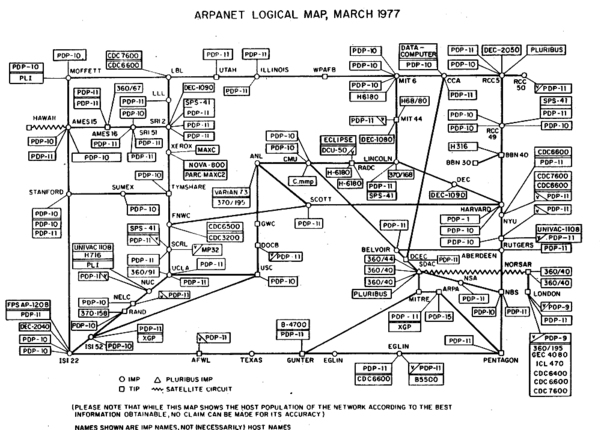
ARPANET (Advanced Research Projects Agency Network) was the world's first operational packet switching network as well as the first network to implement TCP/IP. The Packet switching process was first suggested by Leonard Kleinrock but he ended up leaving DARPA before he could see his theory in practice. Before he left though, he convinced his successors Ivan Sutherland, Bob Taylor, Lawrence G. Roberts, of the importance of his packet switching networking concept.
Before they could begin, they had to figure out how to make the computers talk to one another. In 1965, Roberts working with Thomas Merrill connected a TX-2 computer in Massachusetts to a Q-32 computer in California through a low speed dial-up telephone line (circuit switching) creating the first wide-area computer network ever built. What they found from this experiment was that the time-shared computers could work well together, running programs and retrieving data as necessary on the remote machine.
Lawrence G. Roberts taking Kleinrock suggestion seriously began developing a network based on packet switching and in 1967 Roberts presented his paper on ARPANET at a conference. While there, he found out that there were other papers on a packet network concept from the UK by Donald Davies and Roger Scantlebury of NPL, Paul Baran and others at RAND group. It happened that the work at MIT (1961-1967), at RAND (1962-1965), and at NPL (1964-1967) had all happened without any of the researchers knowing about the others work. With so many different network methods it was important for them to find something to unify their work.
In 1968, after Robert E. Kahn of DARPA and ARPANET along with Vinton Cerf of Stanford University had refined the overall structure and specifications for the ARPANET, they gave BBN Technologies a contract to build the network. The BBN proposed a network make up of small computers called Interface Message Processors (IMPs), that would functioned as gateways (today called routers) interconnecting local resources.
Learn More On ARPANET 1968ARPANET Goes Live
In September of 1969, the ARPANET went live. A connection was made between computers at The University of California Los Angeles (UCLA) and The Stanford Research Institute (SRI) creating the first ARPANET link. These two computers would thus become the first and second nodes on the ARPANET. On October 29, 1969 the first host-to-host message was sent from UCLA to SRI.
Two more nodes were added at UC Santa Barbara and University of Utah. These last two nodes incorporated application visualization projects, with Glen Culler and Burton Fried at UCSB investigating methods for display of mathematical functions using storage displays to deal with the problem of refresh over the net, and Robert Taylor and Ivan Sutherland at Utah investigating methods of 3-D representations over the net. Thus, by the end of 1969, four host computers were connected together into the initial ARPANET, and the Internet was officially off the ground.
Sep 1969ARPANET's Public Unveiling
In October 1972, Kahn exhibited the ARPANET at the International Computer Communication Conference (ICCC). This was the first public demonstration of this new network technology to the public. Along with its first public appearance, the initial "hot" application, electronic mail, was introduced. In March Ray Tomlinson at BBN wrote the basic email message send and Learnsoftware, motivated by the need of the ARPANET developers for an easy coordination mechanism. In July, Roberts expanded its utility by writing the first email utility program to list, selectively read, file, forward, and respond to messages. From there email took off as the largest network application for over a decade. This was a harbinger of the kind of activity we see on the World Wide Web today, namely, the enormous growth of all kinds of "people-to-people" traffic.
By 1973, thirty institutions were connected to the ARPANET. However, there were still some problems to work out. Up until this point, operating system had been working on the NCP protocol since there was really no standard but NCP did not have the ability to address networks (and machines) further downstream than a destination IMP on the ARPANET. As mention earlier, with so many different networks they needed something to unify their work. Thus, Kahn and Cerf finally develop a new version of the protocol in 1974 which could meet the needs of an open-architecture network environment. This protocol would eventually be called the Transmission Control Protocol/Internet Protocol (TCP/IP). In 1975, their new two-network TCP/IP communication was tested between Stanford and University College London (UCL).
Learn More On ARPANET Oct 1972TCP/IP
Prior to ARPANET, operating systems had been working on the NCP protocol since there was really no standard. However, NCP did not have the ability to address networks (and machines) further downstream than a destination IMP on the ARPANET. Thus, Robert E. Kahn and Vinton Cerf, the developer of the existing ARPANET Network Control Program (NCP) protocol, developed a new protocol in 1974 which could meet the needs of an open-architecture network environment. This protocol would eventually be called the Transmission Control Protocol/Internet Protocol (TCP/IP). In 1975, their new two-network TCP/IP communication was tested between Stanford and University College London (UCL). Between 1978 and 1983, several other TCP/IP prototypes were developed at multiple research centers but the migration of the ARPANET to TCP/IP protocols was officially and permanently activated in January 1983.
The Transmission Control Protocol/Internet Protocol (TCP/IP) suite is the set of communications protocols used for the Internet and other similar networks. It was different from the NCP since network protocols were hidden by using a common internetwork protocol instead of the network being responsible for reliability. This became the most important feature of TCP/IP because it provides end-to-end connectivity specifying how data should be formatted, addressed, transmitted, routed and received at the destination. It does this through its four abstraction layers which sort all Internet protocols according to the scope of networking involved from lowest to highest, the lowest being the link layer contains communication technologies for a local network, then the internet layer (IP) connects local networks, thus establishing internetworking, then the transport layer handles host-to-host communication. Over time four versions were developed: TCP v1, TCP v2, TCP v3 and IP v3, and TCP/IP v4 but the last protocol is still in use today.
Learn More On TCP/IP 1974Birth of the World Wide Web

Sir Timothy John Berners-Lee, a British computer scientist, is best known as the inventor of the World Wide Web. In March 1989, Tim Berners-Lee of CERN addresses the issue of the constant change in the currency of information and the turn-over of people on projects. In his proposal he referenced ENQUIRE, a database and software project he had built in 1980, and described a more elaborate information management system. Instead of a hierarchical or keyword organization, Berners-Lee proposes a hypertext system that will run across the Internet on different operating systems. With help from Robert Cailliau, he published a more formal proposal in November 1990 to build a "Hypertext project" which would become the World Wide Web. What made the WWW possible was Berners-Lee's innovative idea to join hypertext and the Internet. In the process of combining them, Berners-Lee developed three essential technologies (1) a system of globally unique identifiers for resources on the Web and elsewhere as the Universal Document Identifier (UDI), later known as Uniform Resource Locator (URL) (2) the publishing language HyperText Markup Language (HTML) and (3) the Hypertext Transfer Protocol (HTTP).
In addition to creating HTML, Tim Berners-Lee a few years later went and formed the World Wide Web Consortium (W3C). He is currently the director of the World Wide Web Consortium (W3C), which oversees the Web's continued development. The W3C is comprised of various companies that were willing to create standards and recommendations to improve the quality of the Web. These standards and ideas are freely available to anyone with no patent and no royalties due. The World Wide Web Consortium decided that its standards should be based on royalty-free technology, so that they could easily be adopted by anyone.
Learn More About Tim Berners-Lee 1989World Wide Web Goes Public
The World Wide Web is made available to the public for the first time on the Internet.
1990Creation of Browsers
The first web browser was invented in 1990 by Sir Tim Berners-Lee. His browser was called WorldWideWeb and later renamed Nexus.
A web browser is a software application for retrieving, presenting and traversing information resources on the World Wide Web. It is able to get this information because the information is identified by a Uniform Resource Locator (URL). With the URL the browser is able to find any piece of information be it a web page, image, video or other piece of content.
The first full-text Web search engine was WebCrawler in 1994 since before WebCrawler, only Web page titles were searched. However, the first web browser was invented in 1990 by Sir Tim Berners-Lee. It was originally called WorldWideWeb but and was later renamed Nexus so as not to be confused with his Hypertext Project. In 1993, Marc Andreessen released his browser software called Mosaic (later Netscape) which would become the "the world's first popular browser" and also made World Wide Web system easier to use and more accessible to the average person. From Andreesen's browser idea sparked the internet boom of the 1990s and the “Browser Wars.” As of today the major web browsers are Chrome, Firefox, Internet Explorer, Opera, and Safari.
Learn More About Web Browser History 1990Release Of Linux
Linus Torvalds creates Linux and becomes a leading supporter of Open Source software.
Oct 5, 1991MP3 Is Developed
Brandenburg and his team settle on a file extension for the audio format, shortening MPEG1, Layer 3 to MP3.
1993Start Of Browser Wars
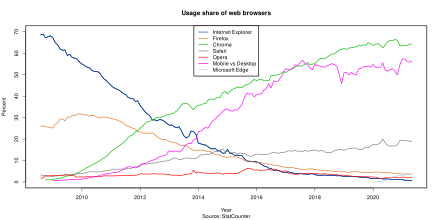
The Browser Wars, a metaphorical term referring to the competitions between Browsers for dominance via usage, started after 1993 when Marc Andreessen released his browser software called Mosaic (later Netscape) which would become the "the world's first popular browser" and also made World Wide Web system easier to use and more accessible to the average person. From Andreesen's browser idea sparked the internet boom of the 1990s and the “Browser Wars.” Microsoft responded with its Internet Explorer in 1995, also heavily influenced by Mosaic, initiating the industry's first browser war. Opera debuted in 1996 but has never achieved widespLearnuse. In 1998, Netscape launched the Mozilla browser that would eventually evolve into Firefox. Apple's Safari was released in April of 2011. The most recent addition to the browser market is Google Chrome, released in September 2008. In December 2011, Chrome overtook Internet Explorer 8 as the most widely used web browser. As of today the major web browsers are Chrome, Firefox, Internet Explorer, Opera, and Safari.
The war still continues today and there is now a new front to concur as the mobile web evolves. As more widespLearnuse of smartphones and other mobile devices has occurred the focus for these browsers has to become mobile. Currently, WebKit has become the most dominant layout engine so far since Internet Explorer, Firefox and Opera — have a poorer experience when viewing most mobile versions of Web sites.
Learn More About Browser Wars 1995Blogs First Appear
The advent of web publishing tools available to non-technical users spurs the rise of blogs.
1998Craigslist
Craig Newmark founds Craigslist, which is to become one of the most widely used websites on the Internet. He changes the way people used classifieds, transforming it into a largely Internet-based industry.
1999RSS

Aaron Swartz co-creates RSS, a program that collects news from various web pages and puts them in one place for readers, with the goal of making information freely available to everyone.
Learn More About RSS 2000XHTML
XHTML (Extensible HyperText Markup Language) was developed based on HTML but fixed many of the problems found in the original. Many pages on the web contained HTMLs that were poorly formed, containing certain errors such as missing closing tags, tags not closed in the proper order, and attributes not quoted. XHTML was created to prevent these errors by setting rules that would eventually result better and more efficient codes for webpage visitors. XHTML 1.0 became the first version of XHTML in January 2000. It contained a bunch of new XHTML syntax rules and XHTML tag rules that needed to be followed. Another feature in XHTML 1.0 was that web developers had to classify their documents into one of three document types which include transitional, frameset, and strict. Next came the XHTML 1.1 edition in 2001. It is not that much different from XHTML 1.0 but introduced the idea of modules which is a set of related elements. The most current version of XHTML is XHTML5 released in September 2009.
Learn More On XHTML Jan 26, 2000Dot-com Bubble

With the spark of the Browser wars there became a Dot-com bubble. Starting roughly in 1997, there was a speculative bubble where stock markets in industrialized nations saw their equity value rise rapidly from growth in the Internet sector and related fields. It is called the Dot-com bubble since during this period there was a large founding of new Internet-based companies commonly referred to as dot-coms. Companies were seeing their stock prices shoot up if they simply added an "e-" prefix to their name and/or a ".com" to the end, which one author called "prefix investing.” With a combination of rapidly increasing stock prices, market confidence that the companies would turn future profits, individuals speculated in stocks. These venture capitalists created an environment in which many investors were willing to overlook traditional financial measure in favor of confidence in the technological advancements.
In March 2000, the dot-com bubble burst. It was caused when in 1999 the U.S. Federal Reserve began to increased interest rates six times in order to slow the economy. A majority of the dot-coms ceased trading because they had burned through their venture capital money. Many never having made a profit because their strategy was "get big fast" therefore they offered their services or end product for free thinking that if they could build enough brand awareness, they could charge profitable rates for their services later. However, that was not the case. By 2001, the bubble's deflation was running full speed. A majority of the dot-coms had ceased trading, after having burnt through their money and venture capital, often without ever making a profit. Of all the hundred, if not thousands, of companies that started, only two companies were able to make it through. They were Amazon and Ebay.
Learn More On Dot-com Bubble Mar 10, 2000Wikipedia

Jimmy Wales launches Wikipedia. There are half a million Internet users.
Learn More About Wikipedia Jan 15, 2001Creative Commons
Under the leadership of Harvard Law School Professor Lawrence Lessig, Aaron Swartz helped build the open architecture for Creative Commons, which works to minimize the barriers to sharing and reusing research and educational materials.
Learn More About Creative Commons 2001Web 2.0
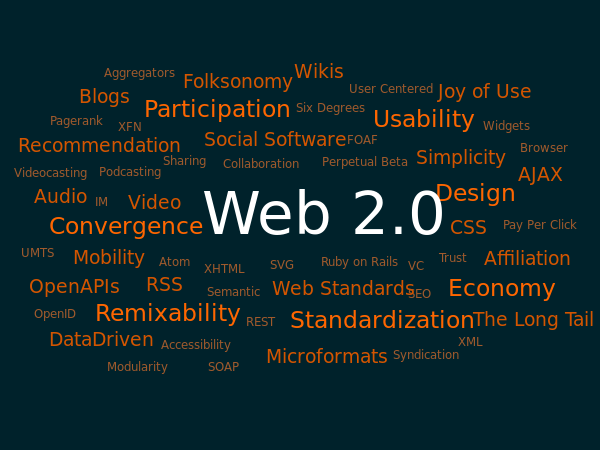
Web 2.0 describes World Wide Web sites that emphasize user-generated content, usability, and interoperability. The term was popularized by Tim O'Reilly and Dale Dougherty at the O'Reilly Media Web 2.0 Conference in late 2004, though it was coined by Darcy DiNucci in 1999.
Traditionally, access to the Web has been via fixed-line services on large-screen laptops and desktop computers. Now however, thanks to the WAP (Wireless Application Protocol) and WML (Wireless Markup Language) the Web is becoming more accessible by portable and wireless devices like smartphones and tablets. The first mobile phone with Internet connectivity was the Nokia 9000 Communicator in 1996. The feasibility of Internet services via mobile phones was limited though since prices were sky high and network providers did not have developed systems and services to conveniently provide this service on phones. In 2001, Research in Motion released their BlackBerry product which could access the Internet but the growth of mobile phone Internet access was more gradual than expected. It was not until 2008 that more mobile devices accessed the Internet than personal computers. Even as far as we have come with mobile technology mobile Web access still suffers from compatibility and usability problems.
The war still continues today and there is now a new front to concur as the mobile web evolves. As more widespLearnuse of smartphones and other mobile devices has occurred the focus for these browsers has to become mobile. Currently, WebKit has become the most dominant layout engine so far since Internet Explorer, Firefox and Opera — have a poorer experience when viewing most mobile versions of Web sites.
Learn More About Web 2.0 2004Facebook Launched
Mark Zuckerberg, along with co-founders Dustin Moskovitz, Chris Hughes and Eduardo Saverin, launched Facebook from their Harvard University dorm. Little did they know how Facebook would changed how we keep in touch and how much or little we share moments in our lives.
2004YouTube Launched
YouTube was founded by Chad Hurley, Steve Chen, and Jawed Karim. What started off as a simply way to share videos redefined entertainment.
Video Entertainment is no longer just movies and TV Shows made by big corporations staring Hollywood Actors. Now people are ‘YouTube famous’ and they make content by themselves or with small teams. These content creators have changed the game because they interact more with their audience and consumers with people who enjoy the same content.
February 14, 2005Twitter Launched
Twitter was created by Jack Dorsey, Evan Williams, Biz Stone, and Noah Glass. Twitter changed the social game because it made a fast flow of information faster giving it a "Real Time" feel.
As it quickly gained popularity it also removed the celebrity filter as lots of stars started giving fans unprecedented access via Photos, updates on their everyday lives, and even chatting with their followers.
July 15, 2006Apple Launches iPhone
Wether you a fan of iPhone or not, we all have to agree it changed the playing field and lead to the rise of Mobile Web.
Jun 29, 2007Mobile Web

Traditionally, access to the Internet had been via fixed-line services on laptops and desktop computers. That all changed with the rise of portable and wireless devices.
What really makes this "era" distinction is the development of "Apps" and Responsive websites. As browsers became more powerful and gained access to the hardware of mobile devices (including accelerometers and GPS chips), and the speed and abilities of browser-based applications improve.
Learn More About Mobile Web 2007Into The Future...
While the Mobile Web has also been called Web 3.0, since it draws parallels to the changes users were experiencing during Web 2.0, we are beginning to see another shift in the winds.
Web 4.0 is going to be all about designing for smaller and smaller screens and making our lives easier via device controls. As "smart watches" and "Google Glasses" rise, more and more everyday items are going to be hooked up to the internet