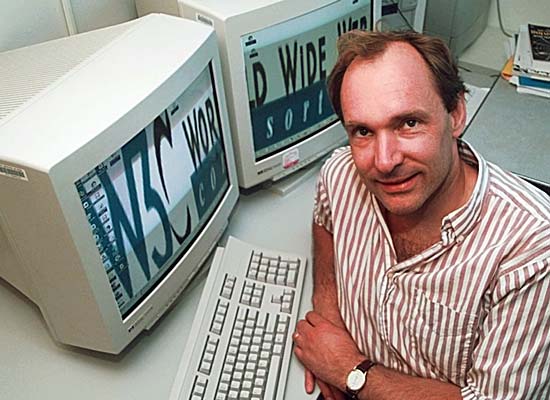
Sir Timothy John "Tim" Berners-Lee, is a British computer scientist, best known as the inventor of the World Wide Web. In March 1989, Tim Berners-Lee of CERN addresses the issue of the constant change in the currency of information and the turn-over of people on projects. In his proposal he referenced ENQUIRE, a database and software project he had built in 1980, and described a more elaborate information management system. Instead of a hierarchical or keyword organization, Berners-Lee proposes a hypertext system that will run across the Internet on different operating systems. With help from Robert Cailliau, he published a more formal proposal in November 1990 to build a "Hypertext project" which would become the World Wide Web. What made the WWW possible was Berners-Lee's innovative idea to join hypertext and the Internet. In the process of combining them, Berners-Lee developed three essential technologies (1) a system of globally unique identifiers for resources on the Web and elsewhere as the Universal Document Identifier (UDI), later known as Uniform Resource Locator (URL) (2) the publishing language HyperText Markup Language (HTML) and (3) the Hypertext Transfer Protocol (HTTP).
In addition to creating HTML, Tim Berners-Lee a few years later went and formed the World Wide Web Consortium (W3C). He is currently the director of the World Wide Web Consortium (W3C), which oversees the Web's continued development. The W3C is comprised of various companies that were willing to create standards and recommendations to improve the quality of the Web. These standards and ideas are freely available to anyone with no patent and no royalties due. The World Wide Web Consortium decided that its standards should be based on royalty-free technology, so that they could easily be adopted by anyone.
XHTML (Extensible HyperText Markup Language) was developed based on HTML but fixed many of the problems found in the original. Many pages on the web contained HTMLs that were poorly formed, containing certain errors such as missing closing tags, tags not closed in the proper order, and attributes not quoted. XHTML was created to prevent these errors by setting rules that would eventually result better and more efficient codes for webpage visitors. XHTML 1.0 became the first version of XHTML in January 2000. It contained a bunch of new XHTML syntax rules and XHTML tag rules that needed to be followed. Another feature in XHTML 1.0 was that web developers had to classify their documents into one of three document types which include transitional, frameset, and strict. Next came the XHTML 1.1 edition in 2001. It is not that much different from XHTML 1.0 but introduced the idea of modules which is a set of related elements. The most current version of XHTML is XHTML5 released in September 2009.